

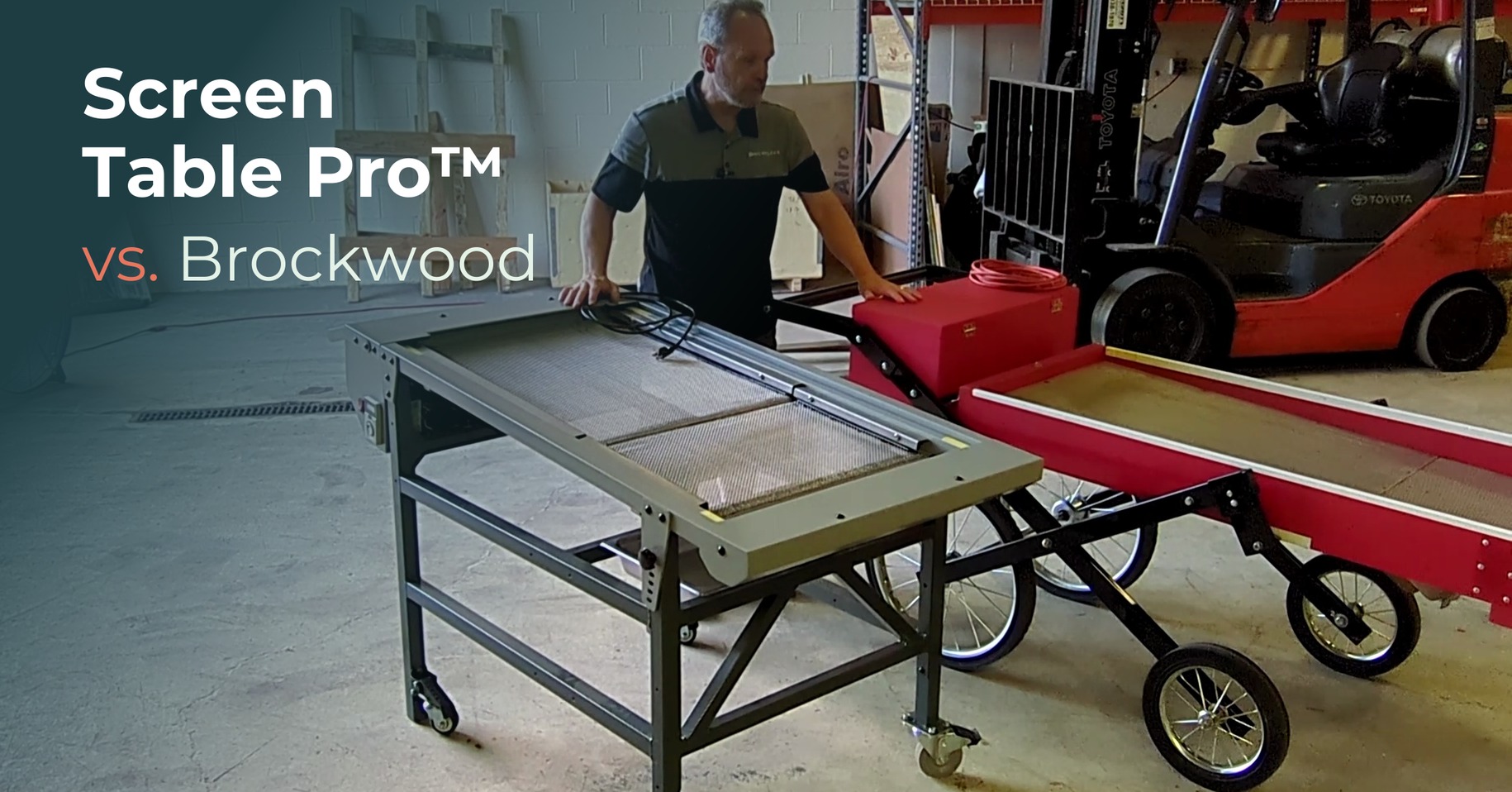
We’ve put it to the test
You have asked us how our Screen Table Pro™ compares to the Brockwood Sifter.
As far as we know, the Brockwood has been the only medium- to large-scale table screener specifically designed to sift vermicastings, worms, and cocoons. Until last year when we started selling the Screen Table Pro™.
Since you asked, our chief engineer couldn’t sleep at night, so we had to find out!
So we set out to fairly compare these two machines using the same material, the same run time, and the same room.
We measured 13 data points and identified 6 design differences, so you can compare the two machines for yourself before purchasing one for your operation. And now he can sleep well again.
Table of Contents
OVERVIEW
PERFORMANCE
DIMENSIONS & HANDLING
DESIGN & BUILD
How We Measured And Compared
Our tools and methodology explained
- Material: two tubs of vermicompost made from horse manure and food scraps, 25 lbs each, identical material.
- Run time: 2.5 minutes on each machine, back to back.
- Screens: 3/32″ first stage, 1/8″ second stage, then overs. Same sizes on both machines.
- Throughput: each 2.5-minute result scaled to one hour.
- Instruments: a scale, a tape measure and a sound level meter. Noise was measured in the workshop and again in the office.
- The Brockwood unit: a real working machine, several years old, stored under cover its whole life and in good condition.
Results at a Glance
| Data point | Screen Table Pro™ | Brockwood |
|---|---|---|
| Throughput | 482 lbs/hour | 408 lbs/hour |
| Screen open area (3/32″) | 57% | 31% |
| Speed | Variable, 250–375 CPM | Fixed, 400 RPM |
| Noise | 65 dB | 73 dB |
| Screen change time | ~ 6 min | ~ 15 min |
| Length with handle | 60″ | 76″ |
| Widest point | 32″ | 33½” |
| Working height | 35″ | About 28″ |
| Container clearance | 26″ | About 20″ / 17″ |
| Screen sizes offered | 5 | 3 |
| Screen sets included | 2 | 1 |
| Screen width | 21″ | 21″ |
| Overall height | 36″ | 36″ |
Design differences
| Design point | Screen Table Pro™ | Brockwood |
|---|---|---|
| Screen motion | Vertical | Side to side |
| Mobility | 4 locking casters | 2 wheels, front wheel fixed |
| Chutes | One-piece stainless steel, 45° | Sewn and stapled vinyl |
| Contact materials | Stainless steel | Wood and perforated aluminum |
| Cocoon tray | Included | None, drop of almost 2 ft |
| Loading side | Back | Front |
Performance
Throughput: 482 vs. 408 lbs per Hour
18% more sellable product from the same material in the same time.
Throughput is the number that matters most in commercial vermicast screening, so it comes first. Both machines screened 25 lbs of identical material for 2.5 minutes.
| Fraction | Screen Table Pro™ | Brockwood |
|---|---|---|
| Fines (first stage, 3/32″) | 20.1 lbs | 17.0 lbs |
| Second stage (1/8″) | 1.2 lbs | 1.7 lbs |
| Overs | 3.7 lbs | 6.3 lbs |
| Fines scaled to one hour | 482 lbs | 408 lbs |
The Screen Table Pro™ produced 74 lbs more sellable product per hour. The difference shows up in the overs: 3.7 lbs instead of 6.3 lbs. Those fines were in the material on both machines. The Screen Table Pro™ separated them; on the Brockwood, they stayed in the overs.
Two design decisions account for the result: the vertical screen motion and the open area of the woven mesh.
Screen Open Area: 57% vs. 31%
Woven wire mesh vs. perforated aluminum sheet, both at 3/32″.
Hole size alone does not determine how well a screen separates. Open area does: the share of the screen surface that is actually opening. We chose woven wire mesh for the Screen Table Pro™, which gives 57% open area at 3/32″. The Brockwood uses perforated aluminum sheet, which gives 31% at the same hole size.
That is 1.8 times the open area. On every pass, a fine particle has nearly twice the chance to find an opening and drop through.
Speed Control: Variable 250–375 CPM vs. Fixed 400 RPM
Adjustable screening speed for different materials.
Damp bedding and dry, finished castings do not screen best at the same speed. That is why the Screen Table Pro™ has a control panel on the side with a main switch, a standby switch, a variable speed dial and a digital readout in cycles per minute (CPM). It leaves our shop set to around 300 CPM and runs anywhere from 250 to 375 CPM, or lower when you need it.
Inside, a driveshaft turns dual crank plates and connecting rods that drive the screen frame. The standby switch brings the screen to a smooth stop. The main switch serves as an emergency stop.
The Brockwood runs a 1/3 HP motor at a fixed 400 RPM. One speed for every material.
Note: the Brockwood is specified by motor speed (RPM), the Screen Table Pro™ by screen cycles per minute (CPM). The two figures describe different quantities and are not directly comparable.
Noise Level: 65 dB vs. 73 dB
An 8 dB difference, measured with a sound level meter.
As a rule of thumb, a 10 dB increase is perceived as twice as loud. An 8 dB difference means the Screen Table Pro™ sounds a little more than half as loud as the Brockwood.
We measured both machines in the workshop and again in an office.
- The Screen Table Pro™ averaged 65 dB.
- The Brockwood averaged 73 dB.
Volume is only part of it. Engineers describe machine sound as NVH: noise, vibration and harshness. If the screener runs in the same building where you work, harshness is what you notice over a full afternoon.
The inside of the Screen Table Pro™ cover is lined with acoustic foam, to soften vibrations and harshness.
Screen Change Time: Under 6 Minutes vs. About 15
Tension rails instead of 27 screws.
The Screen Table Pro™ holds its screen inserts with tension rails. Eight bolts in total, four per side, loosened with a 3/16″ hex key or a power bit. The rails hook onto the screen inserts and pull them tight into position. A full screen change took just under 6 minutes.
On the Brockwood, the perforated screens are screwed down to the wood frame with 27 screws. On a machine that has been in service for a while, not all of them come out easily. The same change took about 15 minutes.
Dimensions and Handling
Footprint: Just Under 60″ vs. 76″ Long
More than 16 inches shorter, with the same screen width.
Both machines share the same 21″ screen width and the same 36″ overall height to the top of the motor housing. The difference is length.
The Screen Table Pro™ measures 56″ to the motor housing and just under 60″ with the handle. The Brockwood measures 65″, or 76″ with the handle.
Doorway Width: 32″ vs. 33½” at the Widest Point
Both fit through a standard 36″ door. The Screen Table Pro™ with more room to spare.
The widest point of the Screen Table Pro™ is 32″, at the slope adjustment knob. On the Brockwood it is 33½”, at the nut on the front axle. In a standard 36″ doorway, that is 4″ of clearance compared to 2½”.
Working Height: 35″ vs. About 28″
Standard benchtop height for the screening surface.
The screen surface of the Screen Table Pro™ sits at 35″, the height of a standard workbench. On the Brockwood, the working surface is closer to 28″. That 7″ difference is what decides how much you bend over the machine during a full day of screening.
Container Clearance: 26″ vs. About 20″
Room for full-size totes, loaded from the back.
Under the Screen Table Pro™ there are 26″ of height, 26″ between the legs front to back, and 36″ of depth. That fits one long tote across the whole bottom, or a smaller container in front and a larger one in the back. It loads from the back, so a full tote does not have to pass a brace.
The Brockwood loads from the front, because the rear axle blocks the back. There are about 20″ of clearance under the output chute and 17″ under the second stage chute, which fits a 27-gallon tote. The second stage and overs chutes sit about 8½” apart center to center, which limits you to two 5-gallon buckets there.
Mobility: Four Locking Casters vs. Two Wheels
Turns 360° in place and stays put while running.
The Screen Table Pro™ stands on casters at all four legs. It turns a full 360° in place without lifting, and the casters lock so the machine stays exactly where you put it while it runs.
The Brockwood rolls on two large wheels, 20″ at the rear and 13″ at the front. The front wheel is fixed, so changing direction means lifting the machine, which is why it has a long handle. It also tends to move while it runs, and owners often chock the wheels.
Design and Build
Screen Motion: Vertical vs. Side to Side
Material meets the openings head-on.
On the Brockwood, the screen bed rests on rollers and the whole box frame travels a little over an inch back and forth off a connecting rod. Material slides down the sloped screen until it passes over a hole and drops through. A particle that skates across an opening keeps moving and ends up in the overs.
The Screen Table Pro™ moves the screen vertically. Material is lifted off the screen surface and lands back on it, meeting the openings head-on instead of sliding across them. Together with the higher open area, this is where the throughput difference comes from.
Screen Sizes and Included Sets: 5 Sizes, 2 Sets vs. 3 Sizes, 1 Set
Match the screen to the product you sell.
Screen Table Pro™ is available with five screen sizes, from 3/32″ to 9/32″. That range goes finer than 1/8″ and coarser than 1/4″, so you can choose the screen for the product you want to sell.
Two complete sets ship with the machine: two first stage and two second stage screens.
The Brockwood offers three sizes: 3/32″, 1/8″ and 1/4″. It ships with one complete set in the size of your choice.
Chutes: One-Piece Stainless Steel at 45°
Steep enough for wet material to slide on its own.
Screen Table Pro™ chute is a single piece of stainless steel, welded onto a frame and angled at 45° at every stage, including the exit. At that angle, wet material slides down without help.
Brockwood uses Naugahyde, a fabric-backed vinyl, sewn together and stapled around the perimeter. The cocoon stage has steep walls and works well. The shallower stage holds on to wet material, so it needs to be brushed off regularly. One chute sits about 17″ above the floor, close to the containers underneath.
Materials: Stainless Steel Wherever It Touches Worms and Castings
Laser-cut steel, MIG welded, powder coated.
The Screen Table Pro™ is built from sheet steel and a tubular frame, precision cut and drilled by laser, MIG welded and cross-braced for rigidity. It is finished in a two-tone industrial polyester powder coat. Every surface that touches worms or castings is stainless steel.
The Brockwood combines a tubular steel frame with a wood body and fabric chutes. The carpentry is solid and the joints are tight, and the paint on our several-years-old unit has held up well. Its perforated aluminum screens are screwed down to the wood.
Cocoon Tray: Included
A drop of a few inches instead of almost two feet.
The Screen Table Pro™ comes with a cocoon tray as standard. Worms and cocoons drop a few inches before they land. On the Brockwood, they fall almost two feet into the buckets below the chutes. For a machine that handles livestock, we consider that a design requirement.
Conclusion
The Brockwood is a well-built machine, and it has served worm farmers for a long time. It is the reason there is a benchmark at all.
The Screen Table Pro™ is what a modern screen table looks like when it is designed and engineered the Wormgear way: deliberate decisions on screen motion, mesh, drive, materials and ergonomics, and then the measurements to show what those decisions do.
Across 13 measured data points, the Screen Table Pro™ screens more sellable product per hour, runs quieter, changes screens faster, takes up less floor space and puts the work at a better height.
See the Screen Table Pro™ or watch the full 15-part series. If you have questions about your material, your setup or which screens fit your product, reach out or get a quote. You will talk to a real person who knows this equipment.
Frequently Asked Questions
How many pounds per hour does the Screen Table Pro™ screen?
In our side-by-side test, it produced 482 lbs of sellable product per hour, compared to 408 lbs for the Brockwood on identical material.
How was the test set up?
Two tubs of vermicompost from horse manure and food scraps, 25 lbs each, 2.5 minutes on each machine, back to back in the same room. Both machines ran a 3/32″ first stage and a 1/8″ second stage screen.
How loud is the Screen Table Pro™?
It averaged 65 dB on a sound level meter, measured in the workshop and again in the office. The Brockwood averaged 73 dB.
Will the Screen Table Pro™ fit through a standard door?
Yes. Its widest point is 32″, at the slope adjustment knob, so it fits through a standard 36″ doorway.
What screen sizes are available?
Five sizes, from 3/32″ to 9/32″. Two complete sets ship with the machine.
How long does a screen change take?
Just under 6 minutes. Eight bolts, four per side, with a 3/16″ hex key or a power bit.
Is the Brockwood a bad machine?
No. It is well built and has set the standard in this category for years. That is exactly why we compared against it.